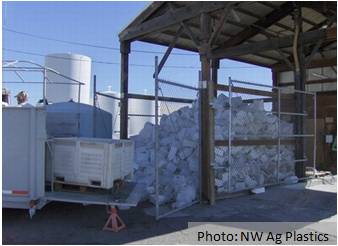
 Most non-refillable containers are made of high-density polyethylene (HDPE) plastic; some are constructed of metal. Recycling and landfills provide disposal options. All nonrefillable plastic containers must be rinsed prior to recycling (instructions for acceptable containers can be found at USAg Recycling and the Ag Container Recycling Council). Note that the type of plastic in the cap on the container is different from the type of plastic in the container. Rinse the cap and dispose of it with your normal refuse; take the uncapped, rinsed container for recycling. The rinsed container cannot be recycled through a household recycling service and must be processed by an approved pesticide container recycler, the Ag Container Recycling Council (ACRC).
Immediately rinse nonrefillable plastic containers when you fill the sprayer. Drain the container rinse water directly into the spray tank. Rinsing immediately (pressure or triple-rinse) easily removes all product concentrate and renders the container sufficiently clean to recycle or send for disposal. Do not allow any residue to become dried and difficult or impossible to rinse; if this occurs, the container is considered full and is classified as expensive hazardous waste. Federal regulations provide that properly rinsed plastic containers become a general waste product that can be recycled by an approved “pesticide container recycler”, or disposed of at a landfill or waste transfer station.
As of 2010, labels on non-refillable plastic containers state the following use instructions: “Do not reuse or refill this container. Once cleaned, some agricultural plastic pesticide containers can be taken to a container collection site or picked up for recycling. Triple-rinse the container (or equivalent) promptly after emptying.” Instructions for triple-rinsing are included on the label. Pressure-rinsing is an accepted equivalent of triple-rinsing.
Compiled by Carol Ramsay
