Proper cleanup of the spillage is essential to remove all health and environmental hazards created by the spill. Use the buddy system when cleaning, and do not work alone. Everyone must be wearing the proper PPE. Assure that there is good ventilation when cleaning and decontaminating the site.
- Dry spills. (granular, dust, wettable, dispersible, and soluble powder formulations)
- Cover the spill with plastic or a tarp to prevent a breeze from moving the material.
- Put weights on the cover.
- Use a broom, dustpan, or shovel to sweep up the spill while rolling back the tarp to expose only a small area at a time.
- Place spillage in metal or plastic containers. Plastic bags may be used, but only as a last resort.
- Secure and label the containers for later disposal. If at all possible, assess the volume of spilled material, review the label and application rates, and then apply as a legal application. Use of the product, though not necessarily for pest control, is legal and allows the material to breakdown under normal application conditions; thus, negating the possible need to handle the material as expensive hazardous waste. If application is not possible, dispose of, as hazardous or non-hazardous waste. See Pesticide Disposal
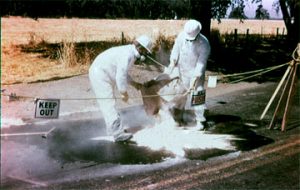 Liquid spills.
- Soak up the liquid with an appropriate absorbent. (sweeping compound, sawdust).
- Use a broom to work the absorbent into the spill.
- Gather the combined material and deposit it in a labeled plastic or metal container.
- Contaminated soil may need to be removed. Soil should be packaged in labeled containers for later disposal. If at all possible, assess the volume of spilled material, review label and application rates, and then apply as a legal application. Use of the product, though not necessarily for pest control, is legal and allows the material to break down under normal application conditions; thus, negating the need to handle the material as expensive hazardous waste. If application is not possible, dispose of the material as hazardous or non-hazardous waste depending on the product.
Decontaminate the Area
After the bulk of the spill has been removed, apply the appropriate decontamination material. The material chosen depends on the pesticide spilled.
- Apply the appropriate solution and allow 1 to 6 hours for the chemicals to work.
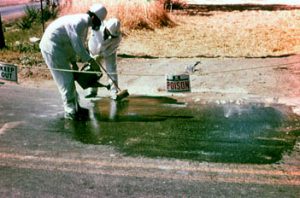
- Dry decontaminants are sprinkled in a thin layer over the spill area. The powder needs to be activated with water. A watering can is used to wet the powder lightly.
- Liquid decontaminants may be applied lightly to the spill area with a watering can.
- Use an absorbent to collect the residues.
- The decontamination procedure is repeated until all the spilled pesticide is removed.
- Tools are cleaned with soap and water or an appropriate decontaminant.
- Collect all used decontaminants and rinse water for disposal.
Initial compilation by: