Minimize the amount of pesticide discarded by following these guidelines:
- Use an integrated pest management (IPM) program to manage pests.
- Buy only the amount of pesticide needed for one season.
- For each application, calculate how much diluted pesticide is required for the job and calibrate equipment. Use all the mixed pesticide in accordance with label instructions.
- Use older pesticides first so that products are less likely to go out of date before use.
- Apply rinse water containing pesticide residue to labeled-use sites.
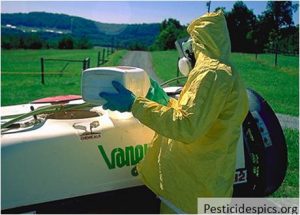
- If equipment is not rinsed on a pad where the rinsate is contained within a sump, wash equipment in the field where the application is made. If field rinsing is done on a repeated basis, make certain to rinse the equipment in various locations of the field where the pesticide is applied. This will prevent the buildup of residues in one area.
- The use of sprayers with in-line pesticide injection systems eliminates excess spray mixture entirely. The pesticide and water are kept in separate tanks, and a separate metering pump feeds the pesticide into the spray line. Any excess water is left in the water tank, and excess pesticide remains in the pesticide tank.