Trees, Shrubs and Plants
Calibration Steps |
Sample Problem
|
| 1. Select a single representative plant or group of plants | 10 cabbage plants |
| 2. Add plain water to the tank and pump it to capacity. Do not add the pesticide product at this time.
Put a hollow cone tip in the nozzle and adjust the nozzle to deliver a fine spray (small droplets are less apt to roll off the leaf surface). Apply the water so that all parts of the plants are covered uniformly. Be sure to treat the underside of leaves as well as the upper side. Record the amount of time required to achieve adequate coverage. |
60 seconds to properly treat 10 cabbage plants
|
| 3. Spray plain water into a bucket for the amount of time recorded in Step 2. Measure and record the amount of water in the bucket | 1 qt of water sprayed into bucket in 60 seconds. |
| 4. Compute the amount of product needed to treat the test plant or group of plants. | One quart of spray will treat 10 cabbage plants. If 1 quart will treat 10 plants, 4 quarts (one gallon) will treat 40 plants. The label says to use 4 tsp / gal water |
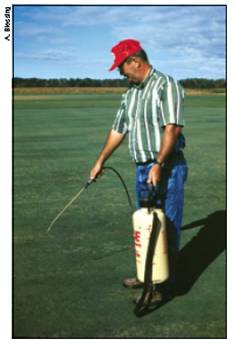
Small Areas of Turf
Calibration Steps |
Sample Problem |
| 1. Pour one gallon of plain water into the tank and pump the sprayer to capacity. Do not add pesticide at this time.
Put a fan tip in the nozzle and adjust it to deliver a coarse spray; large droplets are less apt to drift off-target and heavy enough to penetrate through the grass. While standing still on dry pavement, hold your arm extended while moving the spray wand back and forth just as you would while spraying the lawn. Measure the width of the area that received the spray. |
width of sprayed area on pavement is 4 ft
|
| 2. Spray the pavement, moving in a straight line and maintaining the 4-foot swath width, for 15 seconds. Measure the length of the strip covered in 15 seconds. | length of sprayed strip is 25 ft |
| 3. Compute the total area covered by multiplying the width of the strip (Step 1) by the length (Step 2). | 4 ft x 25 ft = 100 ft2 |
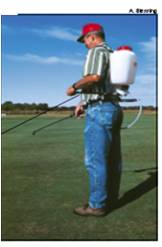
Compiled by Wayne Buhler, PhD.