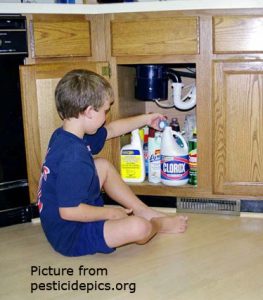
 Whether or not you have young children in your home, take the following precautions to protect all children from unintentional pesticide poisonings or exposures:
- Always store pesticides and other household chemicals out of children’s reach, in a locked cabinet or garden shed. Installing child-proof safety latches or padlocks on cupboards and cabinets is a good idea. Safety latches are available at your local hardware store or building supply warehouse.
- Before applying pesticides – indoors or outdoors – remove children and their toys, along with any pets and their toys, from the area. Keep them away from the area that has been for at least the length of time printed on the pesticide label or until the pesticide has dried.
- If you are interrupted while applying a pesticide – by a phone call, for example – be sure to close the pesticide container properly and put it out of reach of any child who may come into the area while you are gone.
- Never remove labels from containers.
- Never transfer pesticides to other containers. Children may mistake them for food or drink.
- Never put rodent or insect baits where small children can find them, pick them up, and put them in their mouths.
- Make sure you close any container marked “child-resistant” tightly after use. Check periodically that the product is securely closed. Child-resistant does not mean child-proof.
 Make sure others – especially babysitters, grandparents, and other caregivers – know about the potential hazards of pesticides.
- Teach children that “pesticides are poisons” – something they should never touch or eat.
- Keep the poison center telephone number (1-800-222-1222) near each phone. Have the pesticide container on hand when you call.
For more information on protecting children from pesticide exposure:
- Ten Tips to Protect Children from Pesticide and Lead Poisoning. U.S. Environmental Protection Agency. Fact sheets offering tips to protect children from pesticide and lead poisonings.
- Everyone Deserves a Safe and Healthy Home: A stakeholder guide for protecting the health of children and families. U.S. Department of Housing and Urban Development.
For information on protecting pets from pesticide exposure:
- Read the Label First: Protect Your Pets. U.S. Environmental Protection Agency. Government pesticide fact sheets on How to protect your pets from harmful pesticides.
Compiled by Wayne Buhler, PhD.