Turn on more accessible mode Turn off more accessible mode Skip Ribbon Commands Skip to main content
Pesticide Environmental Stewardship
Promoting Proper Pesticide Use and Handling
Supported by CIPM

Center for Integrated Pest Management

Insecticide Resistance Mechanisms

Skip Navigation Links
Home
Topics
Sponsors and Partners
Resources
Terms/Acronyms
Ask a Question
How to Read the Label
Record Keeping
Disposal
Drift
Surface and Groundwater
Wildlife and Pollinators
Storage
Handling Containers
Spills
Terms & Acronyms
Calibration
Homeowner
IPM
Resistance
Soil Fumigation
Transportation
The Worker Protection Standard
Personal Protective Equipment
Protecting Pollinators
Scroll up
Scroll down
Acronyms
Terminology
Agricultural Terminology Links
Scroll up
Scroll down
Skip Navigation Links
Home
How to Read the Label
Calibration
Disposal
Drift
Handling Containers
Homeowner
IPM
Personal Protective Equipment
Pollinator Protection
Recordkeeping
Resistance
Understanding Resistance
Preventing Resistance
Herbicide Resistance
Herbicide Resistance Terms to Know
Is Resistance to Blame- Herbicide
Incidence and History of Herbicide Resistance
Mechanisms of Herbicide Resistance
Proactive Herbicide Resistance Management
How to Manage Herbicide Resistance
Spraying by the Numbers- Herbicide
Resources and Suggested Reading
Resistance Lessons
Insecticide Resistance
Is Resistance to Blame
Raised Resistance Risks
Insecticide Resistance Mechanisms
Take Steps to Avoid Insecticide Resistance
Spraying by the Numbers
What Can You Do About Resistant Insects
Resources and Suggested Reading
Fungicide Resistance
Fungicide Terms to Know
Is Resistance to Blame?
Mechanisms of Fungicide Resistance
Raised Resistance Risks
Proactive Fungicide Resistance Avoidance
Spraying by the Numbers
How to Manage Fungicide Resistance
Soil Fumigation
Spills
Storage
Surface and Groundwater
Transportation
Wildlife Protection
Worker Protection Standard
Skip Navigation LinksPesticide Environmental Stewardship > Resistance > Insecticide Resistance > Insecticide Resistance Mechanisms
Insecticide Resistance Mechanisms
Compiled by Wayne Buhler
Page Content

Insecticide Resistance Mechanisms

There are several ways that insect populations can become resistant to insecticides, and pests may exhibit more than one of these mechanisms at the same time.
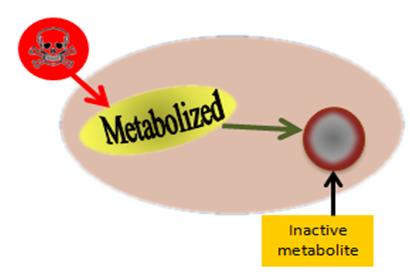
 
Metabolic resistance. Resistant insects may detoxify or destroy the toxin faster than susceptible insects, or prevent the toxin from reaching target sites by binding it to proteins in their bodies. Metabolic resistance is the most common mechanism and often presents the greatest challenge. Resistant insects may possess higher levels or more efficient forms of the enzyme(s) that break down insecticides to nontoxic compounds.
​
I-CideMetab.pngInsect Cell ​
 
 
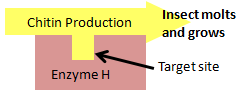
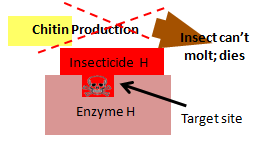
Altered target-site resistance. The site where the toxin usually binds in the insect becomes modified to reduce the insecticide's effects
i.ChtnPrdctn.png
 
​ii.ChtnPrdctnNo.png
​Chitin is a major component of an insect's exoskeleton. In this example, enzyme H is necessary for chitin production (i). To prevent molting, the insecticide binds with the target site (ii). In a resistant insect, the target site is altered (iii) and prevents the insecticide from binding with the enzyme. ​iii.ChtnPrdctnAlt.png

 
underbug.png 
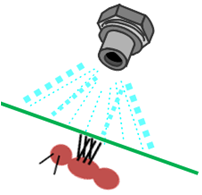
Behavioral resistance. Resistant insects may avoid the toxin by a change from their normal activity. Insects may simply stop feeding or move to the underside of a sprayed leaf. Some malaria-transmitting mosquitoes in Africa developed a preference for resting outside that prevented them from coming in contact with pesticide sprayed on interior walls. 
 
Penetration resistance. Resistant insects may absorb the toxin more slowly than susceptible insects. Penetration resistance occurs when the insect’s outer cuticle develops barriers which can slow absorption of the chemicals into their bodies.  This mechanism is frequently present along with other types.
​Insecticide Resistance Mechanisms
There are several ways that insect populations can become resistant to insecticides.
​ ​Spraying by the Numbers
Insecticide classification scheme that distinguishes modes of action by group numbers.
​Is Resistance to Blame?
Resistance is not the only reason for insect control failure
​
​Take Steps to Avoid Insecticide Resistance
Ways to slow and prevent insecticide resistance from developing.
​

What can you do about Resistant Insects?
What you can do if resistance is already present.
​

Resources and Suggested Reading
  • Additional information about insecticide resistance

​
​Raised Resistance Risks
Conditions that favor increased potential for resistance to develop and spread.

​


  • Home
    Sign In